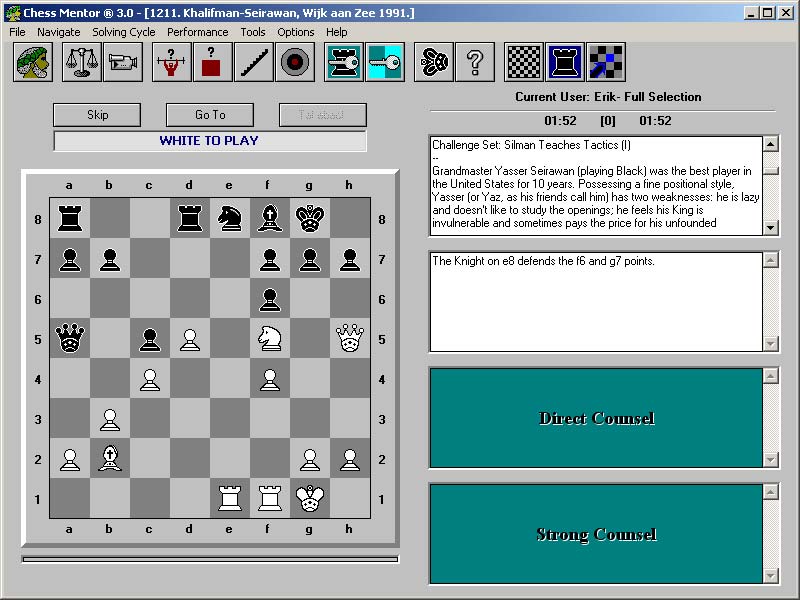
Chess mentor 3
Chess mentor 3. Шахматный тренер
Очередная программа для улучшения навыков игры.
Содержит около 2100 задач по следущим разделам шахматной теории и практики:
| Name | # of challenges |
|---|---|
| Level 1: Start me at the Very Beginning | 92 |
| Level 2: Squares & Rules | 73 |
| Level 3: Basic Checkmates & Positional Strategy | 92 |
| Level 4: Introduction to Tactics | 112 |
| Level 5: Exclusively Checkmates | 104 |
| Level 6: Step Up in Tactics | 63 |
| Level 7: Endings, Openings, and Middle Game | 107 |
| Level 8: Intermediate Tactics | 74 |
| Level 9: Rook and other Endgames | 51 |
| Level 10: Advanced Tactics | 100 |
| Build Your Technique, by FM Thomas Wolski | 110 |
| Kasparov - IBM Deep Blue Matches | 24 |
| Chess Potpourri, by FM Craig Mar | 100 |
| Silman Teaches Tactics, by IM Jeremy Silman | 100 |
| Essential Checkmate Patterns, by FM Thomas Wolski | 130 |
| The King’s Indian Defense, by FM Thomas Wolski | 40 |
| The Sicilian Defense, by FM Thomas Wolski | 41 |
| The Roots of Positional Understanding, by IM Jeremy Silman | 300 |
| World Champions at Their Best (1), by IM Jeremy Silman | 50 |
| World Champions at Their Best (2) - The Lasker Years, by IM Jeremy Silman | 50 |
| Master Your Technique, by FM Thomas Wolski | 50 |
| A Kaleidoscope of Openings, by IM John Grefe | 100 |
| Lessons in Strategy (1), by IM Jeremy Silman | 50 |
| Lessons in Strategy (2), by IM Jeremy Silman | 50 |
| Pawn Endings from Beginner to Expert, by IM Eric Tangborn & FM Thomas Wolski | 103 |
Глядя на количество тем и количество уроков можно сделать вывод, что что-то не так.
Не смотря на то, что тексты упражнений разбавлены юмором и фактами, все вместе они не образуют единую систему. Поэтому совсем новичкам сложно рекомендовать данную программу, а первые два раздела программы можно выкинуть без потерь для ученика.
Сложность заданий растёт нелинейно. А все вместе упражнения напоминают ряд разрозненных примеров, из которых некоторые демонстрируют ряд идей. Примерно с 400 упражнения начинают разыгрывать двуходовки. Среднему игроку интересно становится где-то с 500 упражнения. Что заслуживает уважение, так это то, что каждое упражнение имеет своё название. Сколько времени было потрачено на придумывание названий к упражнением сказать сложно, но это впечатляет.
Следует отметить очень неудобную систему навигации между упражнениями. Все упражнения представлены сплошным списком. Было бы удобнее разбить упражнения на группы согласно темам.
Также из минусов программы можно упомянуть немного глючный интерфейс. Глючность интерфейса проявляется в проблемах при перерисовке доски. Сам интерфейс не менялся с версии программы для Windows 3.11. Из минусов также можно отметить невозможность выставить пользовательский размер шрифта. Всего доступно 3 размера шрифта. Размер шахматной доски также невозможно увеличить.
Что касается цены, то за Chess mentor 3 просят почти 200$. Цена не оправдана.
Из плюсов программы можно выделить отличную систему подсказок для игрока. Можно брать разные подсказки. Каждая последующая подсказка предоставляет больше подробностей, чем предыдущая. Также есть вспомогательные функции для игрока, например, можно подстветить ключевые фигуры или поля, на которые необходимо обратить внимание. Можно также узнать финальное расположение фигур.
На сайте программы предлагается посмотреть веб-версию упражнений. Любопытно, что ссылка ведёт на сайт chess.com.
Что действительно может заинтересовать игроков в этой программе, так это дополнительные курсы, которые идут после 10 уровня. Вот список курсов с их описанием:
-
The Roots of Positional Understanding by IM Jeremy Silman. Are you ever at a loss for what to do when there are no immediate tactics in sight? If so, then you need to learn the basics of positional play. The master seems to optimally place his pieces with effortless ease where they coordinate well and control key lines and squares. This is because he sees the board as a structural entity. Using 300 hundred brief Challenges, Silman gives you the basics of this same positional sense and vision. This module will help you to build strength into your quiet positions. This course module was initially intended for intermediate players with USCF or Elo ratings between 1200 and 1800. However, at least half of the challenges are suitable for those rated between 1800 and 2200 and even higher. Experts and Class A players will find this course module more than challenging with the advanced material and very useful review with the intermediate material. Intermediate players will build a solid foundation with the intermediate challenges and gain more and more from the advanced material as they progress in chess strength.
-
Build Your Technique by FM Thomas Wolski. Wolski follows his popular Master Your Technique with this new course which contains less difficult material. Build Your Technique is aimed at players with USCF or Elo ratings between 1200 and 1600, although some of the later challenges will not be easy for 1800 to 2000 rated players. The 110 challenges include some openings, middlegames, endgames, and a lot of tactics. This course is designed to enhance the overall understanding of chess for an intermediate player and to prepare that player for more advanced courses.
-
Kasparov - IBM Deep Blue Matches. These 24 challenges come from the historic 1996 match and 1997 rematch between World Champion Garry Kasparov and IBM’s Deep Blue super-computer. These are the same challenges that were uploaded to Aficionado’s special website daily as the games were played during the 1997 rematch. These challenges are richly annotated with extensive natural language to allow beginners and novices to follow world class chess with understanding provided by the mentor method. Experienced players will want this collector’s item for their mentor library.
-
World Champions at Their Best (1) by IM Jeremy Silman. This Course is the first in a series that represents Silman’s best work ever and which has the earmarks of becoming a classic. This first Course covers the period from the first World Championship match in 1834 between La Bourdonnais and MacDonnell up to the Steinitz era in the 1880’s. Compared to the modern eras, there is a dearth of literature and analysis regarding pre-twentieth century championship chess. Silman breaks new ground with much original analysis and includes a wealth of historical facts. Utilizing Chess Mentor’s features to their limits, Silman has produced this Course with learning utility for novices as well as International Masters. No one who owns Chess Mentor will want this series missing from their library of Courses.
-
World Champions at Their Best (2) - The Lasker Years by IM Jeremy Silman. Jeremy continues his historical trek, moving on to the games of the man whose reign as World Champion lasted longer than any other – an amazing 27 years. Emanuel Lasker was a polymath; in addition to his chess, he was an accomplished mathematician and philosopher who was also a personal friend of Albert Einstein. Lasker believed that chess was a struggle, and was probably the first champion to take a psychological approach to chess. His games reflect this attitude as he was willing to take tremendous risks, and even intentionally make inferior moves, in order to create uncomfortable positions for his opponents. 50 Challenges with historical background of each player and match.
-
Master Your Technique by FM Thomas Wolski. This Course contains 50 rich and thoroughly analyzed challenges. The majority of these challenges focus on complex middlegame positions, the art of transition from the middlegame to the ending, and on endings themselves. This module is aimed at all players from the intermediate level (about 1400) to strong masters. Experts and Masters (FIDE and USCF Ratings over 2000) will not find these challenges easy. Many of the challenges will be hard for the intermediate player, but they will learn a bit more with each attempt until they become a master of technique. The challenges feature an average length of 10 moves.
-
Lessons in Strategy (1) by IM Jeremy Silman. This Course contains 50 very instructive positional challenges. Some are very long (exceeding 20 moves and one lasts 40 moves), and experts and masters (USCF or Elo ratings above 2000) will not find many of these to be easy. A novice or intermediate level player (USCF or Elo ratings below 2000) will find these challenges quite difficult, but they will learn a bit more with each attempt, all the way until they reach master or higher.
-
Lessons in Strategy (2) by IM Jeremy Silman. This Course continues with 50 strategic positional challenges similar in difficulty to those contained in Silman’s Lessons in Chess Strategy (1). Some are very long, and experts and masters (USCF or Elo ratings above 2000) will not find many of these to be easy. A novice or intermediate level player (USCF or Elo ratings below 2000) will find these challenges quite difficult, but they will learn a bit more with each attempt, all the way until they reach master or higher.
-
Pawn Endings from Beginner to Expert by IM Eric Tangborn. With the 100 challenges in this Course, Tangborn covers king and pawn endings thoroughly. Basic concepts (square of the pawn, king and 1 pawn vs. king basic wins and draws, opposition, triangulation, etc.) are covered. Then the challenges get progressively harder until the final ones cause masters to scratch their heads. King and pawn endings are the basic building blocks for any players’ sound endgame technique and this Course is suitable for novices (USCF or Elo ratings below 1000) all the way up to those approaching expert level (USCF or Elo ratings approaching 2000).
-
Silman Teaches Tactics by IM Jeremy Silman. The 100 challenges in this Course contain combinations and tactical material for intermediate and expert level players (USCF or Elo ratings between 1400 and 2000+). Some challenges here are difficult even for masters and above. However, players of all levels can enjoy and learn from these examples. Less experienced players will go over these challenges many times and continue to learn more each time as they progress in their chess knowledge and experience.
-
A Kaleidoscope of Openings by IM John Grefe. Former US Champion Grefe takes the novice and early intermediate level players (USCF or Elo ratings between 1000 and 1500) on a guided tour of many popular openings. Fundamental opening principles such as rapid development, mobility, struggle for control of the center and sound pawn structures are illustrated through practical examples. Grefe also gives numerous examples of tactical possibilities and traps in various innocent looking positions.
-
Chess Potpourri by FM Craig Mar. This Course with 100 challenges has something for everyone. Mar includes some opening traps, endgames, combinations, and positional challenges. Many of the challenges are at the intermediate level (USCF or Elo ratings between 1300 and 2000) and many are at the expert and master (USCF or Elo rating above 2000) level. Mar chooses positions from many sources including his own games as well as GM’s, IM’s, and also amateurs.
В качестве резюме я бы посоветовал вместо Chess mentor 3 обратить на продукты компании Convekta. Её продукты более конкурентны как по цене, так и по содержанию. Кроме того, Chess mentor 3 доступен только на английском языке, в то время как продукты других компаний поддерживают несколько языков. И также следует упоминуть, что продукты Convekta содержат курсы, каждый из которых представляет собой органичную систему. В то время как с Chess Mentor 3 позволит приятно провести время.
Ссылки
Chess mentor 3 - http://www.chessmentor.com/order_deluxe.html